01
Balance brand distinction with production reality
Startup fragrance teams often begin with a complete visual concept before they know how bottle molds, coating, pumps, caps, boxes, inserts, and MOQ interact. Catalogue combinations start from 300 pieces; logo printing or color coating starts from 500. Handmade bottles start from 500 pieces and 30ml. New custom caps or pumps require 5,000 pieces plus mold fees. Trying to develop a new bottle, original cap, special pump, several surface effects, and a complex rigid box in a small first order can create conflicting requirements.
A practical launch separates the essential brand signals from optional complexity. The bottle shape, color, logo, cap, and box do not all need to carry the same level of customization. YAMEI helps organize the empty bottle and packaging brief, review existing options, coordinate samples, and follow production. It does not guarantee market sales, retail results, a universal low MOQ, or a fixed launch date.
02
Three development routes for a startup brand
The routes below are planning frameworks rather than fixed packages or prices. The correct route depends on quantity, visual priorities, component availability, artwork, timing, and budget. A project can begin with one route and change after existing bottle options or samples are reviewed.
The key decision is where the brand needs true uniqueness. If the silhouette is flexible, decoration and packaging may carry the identity. If the bottle form is central to the brand and expected volume supports development, a custom mold can be assessed. YAMEI compares these conditions without promising that every route is available at the same minimum quantity.
Route A: Existing bottle with simple branding
Use an existing shape with a focused logo process, compatible components, and a practical box structure.
Route B: Existing bottle with coating and custom box
Add controlled color, logo decoration, and packaging while keeping the primary bottle mold unchanged.
Route C: Fully custom bottle development
Catalogue combinations start from 300 pieces; logo printing or color coating starts from 500. Handmade bottles start from 500 pieces and 30ml. New custom caps or pumps require 5,000 pieces plus mold fees.
03
Prioritize one or two brand-defining details
A focused first package is easier to sample and control. The priority might be a bottle color and one-color logo, a distinctive cap and restrained label, or a strong box opening with a standard bottle. These choices can create recognition without combining every available finish. The decision should be based on the intended customer view, not the number of production processes used.
Decoration must suit the actual bottle surface. Fine printing on a curved face, a large foil area, a heavy custom cap, or a dark coating can introduce technical limits. Packaging also needs enough space for required product and market information. Selecting the important visual hierarchy early helps the brand judge samples consistently and avoid late changes that affect MOQ or timing.
04
Understand how MOQ moves across the complete set
The bottle, coating, logo decoration, pump, collar, cap, label, box, and insert may each have different production quantities. Catalogue combinations start from 300 pieces; logo printing or color coating starts from 500. Handmade bottles start from 500 pieces and 30ml. New custom caps or pumps require 5,000 pieces plus mold fees.
An existing bottle normally reduces tooling compared with a new mold, but it does not guarantee a small order for every customization. A custom coating batch or cap can raise the practical quantity. Startup brands should provide an honest expected quantity and identify flexible features. YAMEI can then review which route is proportionate instead of forcing a concept into an unsupported minimum.
05
Plan the box around the actual bottle
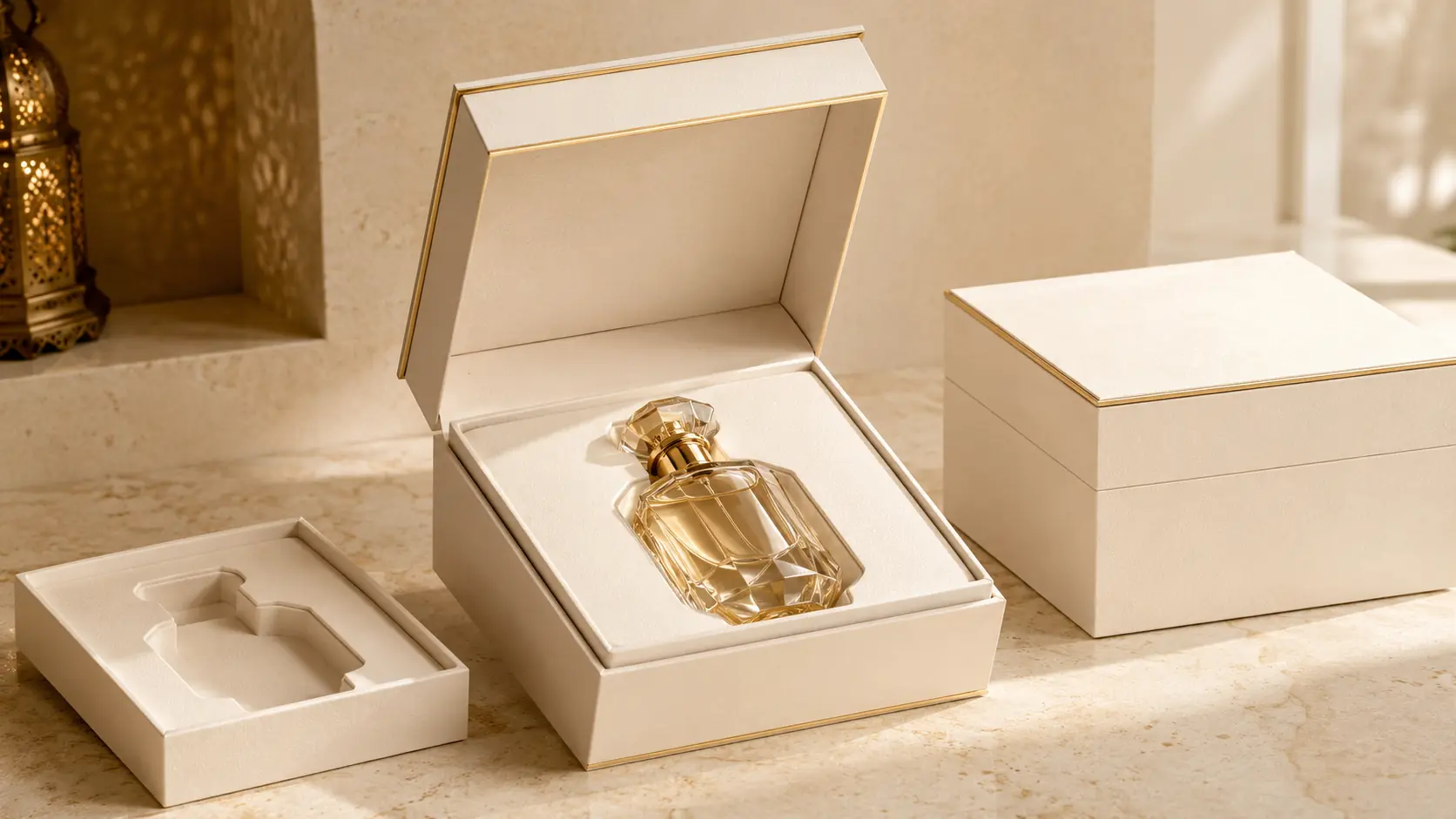
A box cannot be finalized from a 50ml or 100ml label alone. The complete assembled empty bottle dimensions, cap, pump, collar, decoration, weight, and removal direction affect the structure and insert. Two bottles with the same capacity can require different boxes. A structural sample may be needed before artwork and surface finishes are approved.
For a first launch, a proven box structure adapted to the approved bottle can be more practical than a complex custom mechanism. Catalogue combinations start from 300 pieces; logo printing or color coating starts from 500. Handmade bottles start from 500 pieces and 30ml. New custom caps or pumps require 5,000 pieces plus mold fees. The packaging should protect the bottle, support the visual position, and remain appropriate for the intended distribution plan.
06
Use samples to answer defined decisions
Samples are most useful when the brand knows what it needs to approve. A bottle sample confirms shape and feel. A component assembly checks the pump, collar, cap, and total height. A decorated sample confirms color, artwork scale, adhesion, and metallic effect. A box sample confirms structure, fit, removal, materials, and printing. A digital mockup cannot replace these physical checks.
A sample is not a direct forecast of the final unit cost at every production quantity. Tooling, setup, sample methods, and mass-production processes can be priced differently. It also cannot guarantee that a later unapproved change will perform the same way. The approved specification and sample direction become the reference for quotation, production, and quality follow-up.
07
Prepare a launch brief that can be reviewed
Provide the expected quantity, target retail price, bottle capacity, material preference, reference images, logo artwork, target customer, packaging direction, and launch plan. The target retail price is useful as positioning context, not as a required promise or an automatic packaging budget. Explain which visual details are essential and where alternatives are acceptable.
Include known distribution and delivery conditions. Bottle and box choices affect packed volume, weight, protection, and freight planning. YAMEI coordinates delivery for empty bottles and packaging after final packing data are available, but it does not publish fixed freight or promise local stock. The brand remains responsible for its fragrance, filling, finished assembly, product claims, and market launch decisions.
- Expected order quantity and bottle capacity
- Target retail position and intended customer
- Bottle, color, cap, logo, and box references
- Vector logo and available packaging artwork
- One or two non-negotiable brand details
- Target launch plan and destination market
08
Choose the correct project entry
Use the complete bottle and packaging configurator when both elements are being developed for the same launch. It records bottle shape, material, finish, coating, decoration, box, insert, and packaging finish in one summary. The selections communicate direction; they are not fixed products, instant prices, or a guarantee that a complete visual combination can be produced at the submitted quantity.
If the startup already owns a bottle design, drawing, 3D file, or physical sample, use the separate existing-design inquiry. YAMEI can assess whether that design needs new tooling or whether an existing alternative can reach a similar goal. Catalogue combinations start from 300 pieces; logo printing or color coating starts from 500. Handmade bottles start from 500 pieces and 30ml. New custom caps or pumps require 5,000 pieces plus mold fees.
Project Questions
Frequently Asked Questions
Can every startup fragrance brand order a fully custom bottle at a low MOQ?
No. New bottle molds, custom caps, complex coating, and special packaging can require higher quantities and development investment. An existing bottle with selected custom details is often a more practical first route.
Which customization choices should a startup prioritize?
Prioritize one or two details that customers will recognize, such as bottle color, logo decoration, a cap direction, or the box presentation. Concentrating the brief helps control setup and keeps samples easier to evaluate.
Will the bottle and box always have the same MOQ?
Not necessarily. Catalogue combinations start from 300 pieces; logo printing or color coating starts from 500. Handmade bottles start from 500 pieces and 30ml. New custom caps or pumps require 5,000 pieces plus mold fees.